 |
Trax3 3.1.0
trax track library
|
|
Trax3 3.1.0
trax track library
|
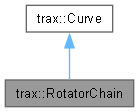
A series of Rotator curves that continue each other. More...
#include <C:/Trend/Development/Trax3/Code/trax/Curve.h>
Public Types | |
| using | SegmentValueType = std::tuple<Angle,Angle,Length> |
| using | Data = std::vector<SegmentValueType> |
| Data defining the curve. | |
| Public Types inherited from trax::Curve | |
| enum class | CurveType { none = 0 , Line , Arc , Helix , LineP , ArcP , HelixP , Clothoid , Cubic , Spline , Rotator , RotatorWithOffset , RotatorChain , PolygonalChain , SampledCurve , Parallel , EEPCurve , EEPResidual , EEPAlternative , Unknown , UserDefined } |
| Curve type identification values. More... | |
Public Member Functions | |
| virtual const Data & | GetData () const noexcept=0 |
| Retrieves the data to construct this curve type. A roundtrip is guaranteed to be invariant. | |
Creation | |
| virtual common::Interval< Length > | Create (const spat::Vector< Length > &advance)=0 |
| Create a RotatorChain that starts and ends with the same tangent and advances by the given vector. | |
| virtual common::Interval< Length > | Create (const Data &data)=0 |
| Create the curve from data set for which it is guaranteed, that no calculational drift will happen e.g. in write/read cycles. | |
| Public Member Functions inherited from trax::Curve | |
| virtual const char * | TypeName () const noexcept=0 |
| virtual CurveType | GetCurveType () const noexcept=0 |
| virtual bool | IsValid () const noexcept=0 |
| virtual AnglePerLength | Curvature (Length s) const =0 |
| virtual AnglePerLength | Torsion (Length s) const =0 |
| virtual bool | IsFlat () const noexcept=0 |
| virtual void | Transition (Length s, spat::Position< Length > &pos) const =0 |
| Copies the 3D Position at the specified location to pos. | |
| virtual void | Transition (Length s, spat::Vector< One > &tan) const =0 |
| Copies the 3D tangential vector at the specified location to tan. | |
| virtual void | Transition (Length s, spat::VectorBundle< Length, One > &bundle) const =0 |
| Copies the 3D Position and tangential vector at the specified location to bundle. | |
| virtual void | Transition (Length s, spat::VectorBundle2< Length, One > &bundle) const =0 |
| Copies the 3D Position and tangential and normal vectors at the specified location to bundle. | |
| virtual void | Transition (Length s, spat::Frame< Length, One > &frame) const =0 |
| Copies the 3D TBN-Frame at the specified location to frame. | |
| virtual std::vector< Length > | ZeroSet () const =0 |
| Returns a list of parameters at which the normal vector flips from one side to the other. | |
| virtual common::Interval< Length > | Range () const =0 |
| virtual spat::Vector< One > | LocalUp () const =0 |
| Gives the Curve's idiosyncratic up direction. Some curves maintain some idea about where they have their upside, either because of their form (e.g Helix) or because it is extra defined (e.g. for Line). Some curves maintain no such notion (e.g. many Cubics). | |
| virtual spat::Frame< Length, One > | GetCurveLocalTransformation () const =0 |
| virtual std::unique_ptr< Curve > | Clone () const =0 |
| make an exact copy of this curve. | |
| virtual bool | Mirror (const spat::VectorBundle< Length, One > &mirrorPlane)=0 |
| Make a Curve with mirrored geometry (but of course one thet returns right handed frames). | |
| virtual bool | Equals (const Curve &toCurve, common::Interval< Length > range, Length epsilon_length=epsilon__length, Angle epsilon_angle=epsilon__angle) const =0 |
| Comparison. | |
| Curve (Curve &&)=delete | |
| Curve & | operator= (const Curve &)=delete |
| Curve & | operator= (Curve &&)=delete |
Static Public Member Functions | |
| static dclspc std::unique_ptr< RotatorChain > | Make () noexcept |
| Makes a RotatorChain object. | |
Additional Inherited Members | |
| Protected Member Functions inherited from trax::Curve | |
| Curve (const Curve &)=default | |
A series of Rotator curves that continue each other.
The Rotator raises the question, wether there could be a simple additive behaviour of those angular rotations. Unfortunately this is not given if Rotator curves are stiched together with their tracks. The reason for this is that in general the rotational axes would not be the same. But it is possible to do such addition based on the same frame of reference, which is what RotatorChain does:
| using trax::RotatorChain::Data = std::vector<SegmentValueType> |
|
pure virtual |
Create the curve from data set for which it is guaranteed, that no calculational drift will happen e.g. in write/read cycles.
| std::invalid_argument | if the curve can not created from the input values. |
|
pure virtual |
Create a RotatorChain that starts and ends with the same tangent and advances by the given vector.
Only the advance.dz is strictly respected, the other two might suffer aberrivations.
| advance | The vector to advance the curve by (end - start) == advance. |
 1.15.0