|
| virtual Length | GetParameter (int idx) const =0 |
| virtual int | UpperBound (Length s) const =0 |
| | The index of the polygonal vertex that is the first one to have greater parameter than s.
|
|
virtual const Data & | GetData () const noexcept=0 |
| | Retrieves the data to construct this curve type. A roundtrip is guaranteed to be invariant.
|
| virtual common::Interval< Length > | Create (const Curve &originalCurve, common::Interval< Length > range, Length maxDeviation, Length minPointDistance)=0 |
| | Creates a polygonal chain from an existing curve.
|
| virtual common::Interval< Length > | Create (std::pair< std::shared_ptr< const Curve >, common::Interval< Length > > originalCurve, Length maxDeviation, Length minPointDistance)=0 |
| virtual common::Interval< Length > | Create (const std::vector< spat::Position< Length > > &samples, WrapTypes wrap=WrapTypes::nonperiodic)=0 |
| | Creates a polygonal chain from a list of sample points.
|
| virtual common::Interval< Length > | CreateCatmullRom (const std::vector< spat::Position< Length > > &samples, WrapTypes wrap=WrapTypes::nonperiodic)=0 |
| | Creates a polygonal chain from a list of sample points.
|
| virtual common::Interval< Length > | Create (const Data &data)=0 |
| | Create the curve from data set for which it is guaranteed, that no calculational drift will happen e.g. in write/read cycles.
|
| virtual const char * | TypeName () const noexcept=0 |
| virtual CurveType | GetCurveType () const noexcept=0 |
| virtual bool | IsValid () const noexcept=0 |
| virtual AnglePerLength | Curvature (Length s) const =0 |
| virtual AnglePerLength | Torsion (Length s) const =0 |
| virtual bool | IsFlat () const noexcept=0 |
| virtual void | Transition (Length s, spat::Position< Length > &pos) const =0 |
| | Copies the 3D Position at the specified location to pos.
|
| virtual void | Transition (Length s, spat::Vector< One > &tan) const =0 |
| | Copies the 3D tangential vector at the specified location to tan.
|
| virtual void | Transition (Length s, spat::VectorBundle< Length, One > &bundle) const =0 |
| | Copies the 3D Position and tangential vector at the specified location to bundle.
|
| virtual void | Transition (Length s, spat::VectorBundle2< Length, One > &bundle) const =0 |
| | Copies the 3D Position and tangential and normal vectors at the specified location to bundle.
|
| virtual void | Transition (Length s, spat::Frame< Length, One > &frame) const =0 |
| | Copies the 3D TBN-Frame at the specified location to frame.
|
| virtual std::vector< Length > | ZeroSet () const =0 |
| | Returns a list of parameters at which the normal vector flips from one side to the other.
|
| virtual common::Interval< Length > | Range () const =0 |
| virtual spat::Vector< One > | LocalUp () const =0 |
| | Gives the Curve's idiosyncratic up direction. Some curves maintain some idea about where they have their upside, either because of their form (e.g Helix) or because it is extra defined (e.g. for Line). Some curves maintain no such notion (e.g. many Cubics).
|
| virtual spat::Frame< Length, One > | GetCurveLocalTransformation () const =0 |
| virtual std::unique_ptr< Curve > | Clone () const =0 |
| | make an exact copy of this curve.
|
| virtual bool | Mirror (const spat::VectorBundle< Length, One > &mirrorPlane)=0 |
| | Make a Curve with mirrored geometry (but of course one thet returns right handed frames).
|
| virtual bool | Equals (const Curve &toCurve, common::Interval< Length > range, Length epsilon_length=epsilon__length, Angle epsilon_angle=epsilon__angle) const =0 |
| | Comparison.
|
|
| Curve (Curve &&)=delete |
|
Curve & | operator= (const Curve &)=delete |
|
Curve & | operator= (Curve &&)=delete |
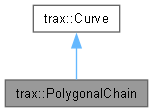
A series of samples of points and tangents that make up a curve.
The intermediate values for the TNB frame, curvature and torsion get linearly interpolated. The curve by definition is parametrized by arc length; the dynamic values in the sample points are calculated like this (see Serret-Frenet):
/// Pi, Ti;
/// Ni = Normalize( (Ti+1 - Ti) - (Ti+1 - Ti) * Ti * Ti ) = Normalize( Ti+1 - Ti+1*Ti * Ti )
/// Bi = Ti % Ni
/// dsi = |Pi+1 - Pi|
/// ki = |Ti+1 - Ti| / dsi
/// ti = (Bi - Bi+1) * Ni / dsi
///
This curve interpolates the dynamic values of a real curve and is meant to be used if only some valid points (and maybe valid tangents) along a real curve are known. To sample a curve with known dynamic data use SampledCurve.

 1.15.0